



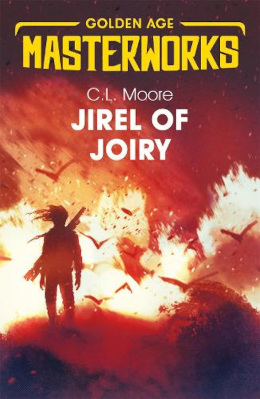
Jirel of Joiry
By C. L. Moore
I really love the cover to this book. Unfortunately, the contents are not nearly as good.
C. L. Moore, Catherine Moore, is not a well known author today, perhaps fading into some obscurity if it were not for some keeping knowledge of the "Golden Age" of Science Fiction alive (a period that started in the 1930's). I recently watched a YouTube talk by Jeet Heer where he talked about The Best of C. L. Moore, which he liked, and that encouraged me to pick this up. These are old stories, first published in Weird Tales magazine, the most famous American pulp. The first story in Jirel of Joiry is "Black God's Kiss" from 1934.
I had to push myself through the first, then the second story here. I reminded myself that I originally found Jack Vance's Tales of the Dying Earth hard going because it seemed "pulpy" and written in quite a "basic" style. But by the end of the first book it had found its footing and I was enjoying it a lot. "Jirel" didn't get better for me though and did not seem to improve. I found it dull and repetitive. Too many descriptions of landscapes and feelings that got a bit boring and turgid after a while. I groaned when I hit the word "skyey". From Black God's Shadow :
A cloud floated across its face, writhed for an instant as if in some skyey agony then puffed into a mist and vanished, leaving the green face clear again.
Jirel is a bit of a female Conan and that should be interesting, but there is almost no fighting or sword play, excitement or world building, let alone character. She gets emotional, with lots of anger, hate, love - but that's about it. I don't often drop a book I'm reading but I gave it up after three stories and decided to move on to something better. I have a big pile of books to read, supposedly good ones. I will give Moore another chance in the future: either Doomsday Morning or Northwest of Earth.
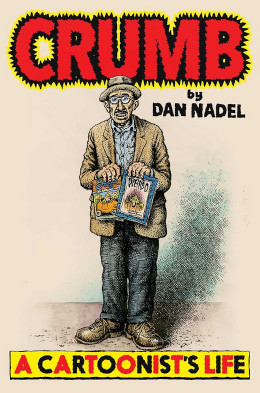
Crumb, A Cartoonist's Life
By Dan Nadel
This is a very recently published book I found in my local library: a biography of the American cartoonist Robert Crumb. He's someone I have had mixed feelings about for a long time but, irrespective of that, I also always recognised him as excellent cartoonist. A natural talent, but also the fruit of many years drawing in his younger days, as this book shows.
I first came across Crumb in a book called "Masters of Comic Book Art", a "coffee table" book published by Aurum Press in 1978. Not a great book looking at it today, but in 1978 it was a revelation to a 12 year old boy. But Crumb was not one of the artists I paid as much attention to. He was too "cartoony" for my taste and I was drawn to the Moebius, Druillet and, particularly, Richard Corben chapters.
But chasing the early work of Corben meant exposure to the world of American "underground" comics and I could not avoid the work of Robert Crumb. He was everywhere, very prolific and the core of Zap Comix, the first "real" underground comic book which debuted in 1968. Alongside fellow artists Rick Griffin, S. Clay Wilson, Spain Rodriguez and Victor Moscoso, his work defined the free-wheeling, wild and often quite "obscene" new counter-cultural comics. Crumb was the driving force of Zap and became famous over the next few years. Of course, "obscenity" is a matter of opinion really but there were serious legal and official attacks on some of the work produced and those who drew, published or distributed the work. First Amendment be damned.
Crumb is also well known for creating some very sexist and racist work on occasion and these pieces are hard to look at today. He's a product of a much more sexist and patriarchal society, and racism was something that was much more casually present than today. Crumb is frank about these works and his various sexual and psychological hang-ups, telling Dan Nadel right at the start that he wants no sugar-coating. Nadel details how badly he sometimes treated the women (particularly) in his life: he was quite the philanderer. It shouldn't come as a great surprise, but a lot of the "hippies" enjoying the drugs and "free love" were the same products of such a society and would happily leave the washing up to the women. Crumb interrogates himself painfully in his note books and letters over his multitude of failings, well aware of the hurt he causes. His very dysfunctional family background must have contributed to this.
For a look at him and, particularly, the relationship with his older brother Charles, see Terry Zwigoff's film Crumb. Charles Crumb, committed suicide in 1992.
Dan Nadel's book is well worth a read and not only for the Robert Crumb story but also a glimpse of all the other underground artists he inspired or worked with. In addition, it's a story of the unfolding of the 1960's "counter-culture", especially what was happening at its epicenter in San Francisco. But this was something that reverberated across the whole of the USA, and Europe as well. Music (Crumb meets Janis Joplin), drugs (lots of LSD taken and pot smoked) and general craziness. Like all these things, the scene dissipated quite quickly with many more undesirable sorts moving in and causing trouble. But the story is fascinating, as is this book.
Crumb is now 82 years old (as of December 2025). Is he still working? Has he mellowed at all? Well, he is still working although his published output has slowed significantly. As for mellowing, he has just had a new comic published by Fantagraphics called Tales of Paranoia and he still seems to be railing against much of the horrible reality of the modern world. Including things like surveillance, vaccine mandates and no doubt much else. He is still Robert Crumb, the famous curmudgeonly comic artist after all.
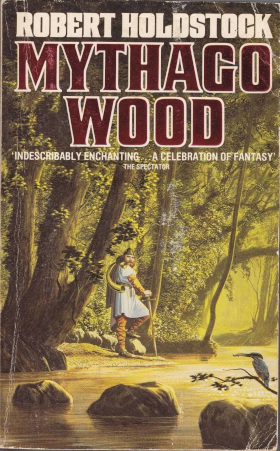
Mythago Wood
By Robert Holdstock
Holdstock's fantasy novel made a big splash back in the 1980's and won some awards. One of the reasons, as mentioned to me in my local SF bookshop, might have been its break with the Tolkien "template" which had been dominating the genre for years.
A "mythago" is a mythic image: something created from the mind of a human being and formed in the real world. They are real bodily things, as real as you or I and can be loved or fall in love, be killed or kill. They might not be human. The created things sprout from myth or history and have a deep, timeless resonance to their source, whether our own unconscious mind or the place itself.
Ryhope Wood seems to have a "supernatural" capability of producing these figures. Inside the ancient wood, we cross one or more thresholds and the normal reality of time and space is broken. A whole world exists separately from ours, peopled by ancient inhabitants and within ancient landscapes.
We meet two brothers, sons of a father obsessed with exploring the wood, living in a house on its edge. When the father dies, each son experiences the draw of the forest and its mysteries. This is also a love story, a chase and a quest. A "created" creature of the wood is Guiwenneth, a young woman with a past steeped in old myth and a pre-Christian world. She is the crux of the novel and the reason for the chase into the further reaches of the forest. Guiwenneth seems to be an avatar of a Celtic warrior princess but also a mythic female figure from long before the Celts appeared. Is there a Jungian collective unconscious? Holdstock explores aspects of this to bring this world to life.
Mythago Wood is a well written adventure book but infused with an exploration of history and myth. This dive through the sights and smells of ancient places and people is the core and what makes it special. It is rooted in the old landscape of an old country, one that has seen many new peoples bringing many new tales. I liked it so much because of that. The novel ends at a point where there is obviously more to say: the sequel is Lavondyss, which I am looking forward to reading.